


In Fiber Optic installation and acceptance testing, Optical Loss measurement is a critical process that helps verify whether the cabling system can transmit data according to the required standards. If signal loss is too high, it can result in network instability, packet loss, reduced transmission speeds, or, in some cases, complete communication failure.
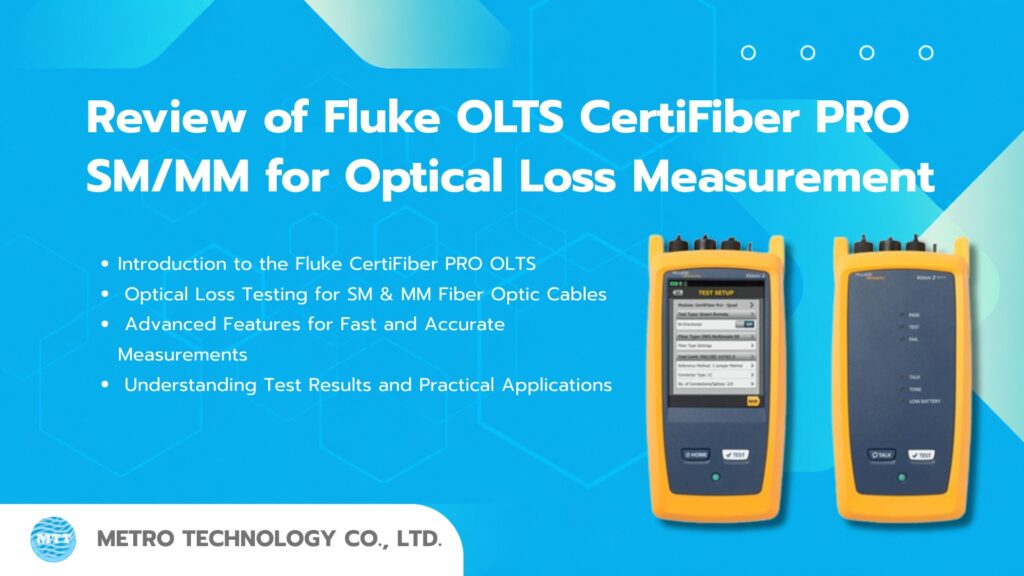
One of the most widely recognized tools for professional Fiber Certification is the Fluke CertiFiber® Pro Optical Loss Test Set (OLTS). It is specifically designed for Optical Loss measurement and fiber optic cable certification in accordance with international standards for both Single Mode (SM) and Multimode (MM) fiber systems.
CertiFiber PRO is not simply a conventional Optical Power Meter. It is a comprehensive solution for Fiber Verification and Fiber Certification, developed to minimize testing errors, increase operational efficiency, and generate professional test reports that meet industry standards.
Overview of Fluke CertiFiber PRO
CertiFiber PRO is part of the Versiv™ platform from Fluke Networks, designed for testing and certification of both copper and fiber optic cabling systems.
One of its key advantages is the ability to perform Optical Loss measurements on both Single Mode and Multimode fiber optic cables within a single instrument. It also supports testing in accordance with ANSI/TIA and ISO/IEC standards commonly used in Data Centers and enterprise network infrastructure projects.
Supports Both Single Mode and Multimode Fiber
One of the major strengths of the Fluke OLTS CertiFiber PRO SM/MM is its ability to test both Multimode Fiber (MM) and Single Mode Fiber (SM) using a single device. This enables installers, contractors, and network engineers to work with a wide variety of fiber optic systems without the need to purchase and carry multiple testing instruments.
Support for both fiber standards makes CertiFiber PRO suitable for applications ranging from in-building network systems to complex long-distance communication infrastructures.
Multimode Fiber (MM)
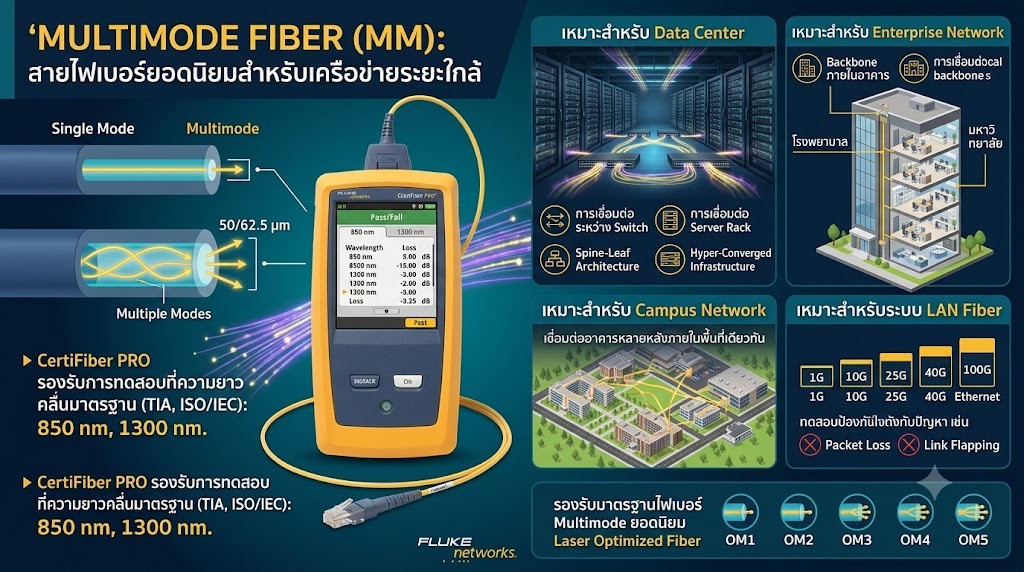
Multimode Fiber is commonly used for in-building and short-distance network applications. Its larger core diameter compared to Single Mode Fiber allows multiple light modes to propagate simultaneously. CertiFiber PRO supports testing at the standard wavelengths used for Multimode Fiber:
- 850 nm
- 1300 nm
These wavelengths are specified by global cabling standards such as TIA and ISO/IEC.
Ideal for Data Centers
Today, many Data Centers utilize Multimode Fiber for internal connectivity because the associated transceiver equipment is generally more cost-effective than Single Mode solutions while still supporting high-speed communications over practical distances.
Typical applications include:
- Switch-to-switch connections
- Server rack interconnections
- Spine-Leaf architectures
- Storage Area Networks (SAN)
- Hyper-Converged Infrastructure (HCI)
CertiFiber PRO can quickly measure the Optical Loss of these links and compare the results against industry standards, ensuring that the fiber infrastructure is ready for production deployment before system activation.
Ideal for Enterprise Networks
Many medium-sized and large enterprise networks continue to use Multimode Fiber as their internal building backbone.
Examples include:
- Corporate headquarters
- Hospitals
- Universities
- Government facilities
- Convention centers
- Commercial buildings
Optical Loss testing with CertiFiber PRO helps verify that every fiber link meets required performance standards, reducing the risk of connectivity issues after project handover.
Ideal for Campus Networks
Campus Networks connect multiple buildings within a single geographic area.
Examples include:
- Universities
- Industrial manufacturing plants
- Large hospital campuses
- Airports
- Industrial estates
Although Single Mode Fiber may be used for longer-distance connections, Multimode Fiber is still commonly deployed for intra-building links.
CertiFiber PRO allows installers to test every fiber link throughout the project using a single testing platform.
Ideal for Fiber LAN Systems
Many modern high-speed LAN infrastructures rely on Multimode Fiber to support network speeds such as:
- 1 Gigabit Ethernet
- 10 Gigabit Ethernet
- 25 Gigabit Ethernet
- 40 Gigabit Ethernet
- 100 Gigabit Ethernet
These high-speed systems are significantly more sensitive to Optical Loss than traditional network infrastructures.
If signal loss exceeds acceptable limits, problems may occur, including:
- Unstable connections
- Packet loss
- Reduced throughput
- Link flapping
- Intermittent network outages
CertiFiber PRO accurately verifies link performance, ensuring that fiber cabling can support high-speed data transmission at its full capability.
Supports Popular Multimode Fiber Standards
CertiFiber PRO is compatible with various Multimode Fiber types, including:
- OM1 (62.5/125 µm)
- OM2 (50/125 µm)
- OM3 Laser Optimized Fiber
- OM4 Laser Optimized Fiber
- OM5 Wideband Multimode Fiber
This covers the majority of fiber optic systems currently deployed in enterprise environments and Data Centers worldwide.
Verifies Quality Before Project Handover
After fiber installation is completed, contractors must demonstrate that the system meets the required installation standards.
CertiFiber PRO performs Optical Loss measurements at both 850 nm and 1300 nm wavelengths and automatically displays Pass/Fail results based on the selected testing standard.
This helps:
- Reduce project acceptance testing time
- Increase confidence in test results
- Generate documentation for project handover
- Support future warranty and maintenance requirements
For these reasons, CertiFiber PRO has become an essential tool for professional Multimode Fiber installation, testing, and certification projects.
Single Mode Fiber (SM)
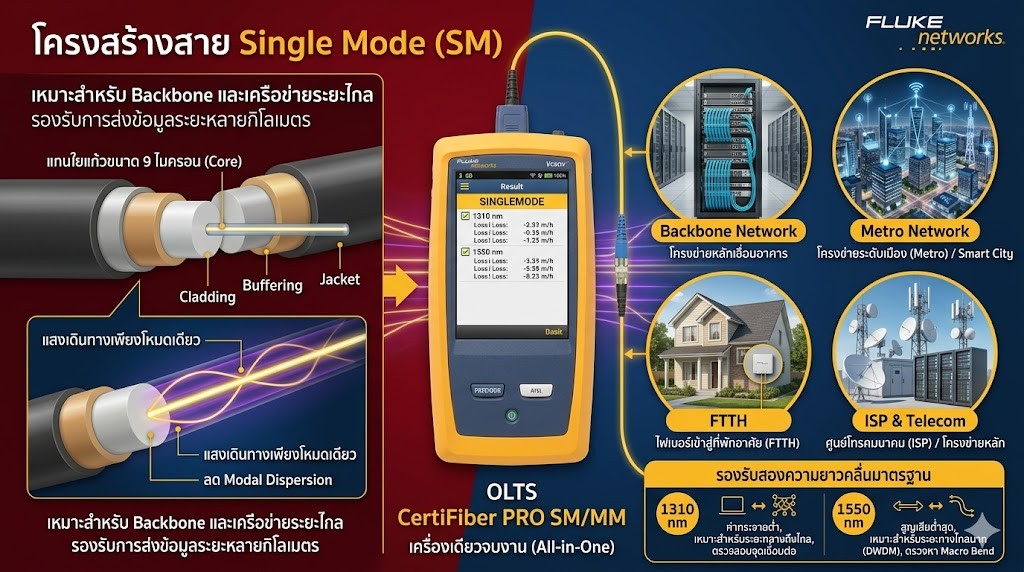
In addition to supporting Multimode Fiber, the Fluke OLTS CertiFiber PRO SM/MM also supports Single Mode Fiber (SM) testing, which is widely used in backbone networks and long-distance communication systems due to its ability to transmit signals over greater distances with lower signal attenuation compared to Multimode Fiber.
Single Mode Fiber features a core diameter of approximately 9 microns, allowing light to travel through a single propagation mode. This significantly reduces modal dispersion and enables high-speed data transmission over distances of several kilometers with excellent performance and reliability.
CertiFiber PRO supports testing at the standard wavelengths used for Single Mode Fiber:
- 1310 nm
- 1550 nm
These wavelengths are commonly used in communication systems and fiber optic networks worldwide.
Supports Testing at 1310 nm
The 1310 nm wavelength has been widely used in Single Mode Fiber systems for many years because it offers low signal dispersion and is well suited for medium- to long-distance transmission.
Measuring Optical Loss at 1310 nm allows installers to verify:
- Whether connection quality meets industry standards
- Whether connectors introduce excessive signal loss
- Whether fusion splices are properly installed and performing correctly
- Whether the system is ready for operational deployment
Measurement results at this wavelength are often used as critical reference data in fiber optic project acceptance documentation.
Supports Testing at 1550 nm
The 1550 nm wavelength provides the lowest attenuation characteristics in Single Mode Fiber, making it ideal for very long-distance communication applications.
Today, this wavelength is commonly used in systems such as:
- DWDM (Dense Wavelength Division Multiplexing)
- CWDM
- Metro Ethernet
- Long-Haul Networks
- Carrier Networks
Optical Loss testing at 1550 nm is particularly important because it can reveal issues that may not be clearly visible at 1310 nm, including:
- Macro bends
- Micro bends
- Improper cable bend radius installation
- Light leakage points
As a result, testing at 1550 nm provides a more detailed and accurate evaluation of overall fiber link quality.
Ideal for Backbone Networks
A Backbone Network serves as the primary communication infrastructure that interconnects all network segments.
Examples include:
- Building backbone networks
- Inter-building backbone links
- Industrial facility backbone systems
- University backbone networks
- Data center backbone infrastructure
These links are critical communication paths, and a single failure can impact a large number of users.
CertiFiber PRO helps verify that Optical Loss levels remain within acceptable limits to ensure reliable operation of network equipment and services.
Ideal for Metro Networks
Metro Networks connect locations across cities or metropolitan areas.
Examples include:
- Branch office interconnections
- Smart City infrastructure
- Telecommunications provider networks
- City-wide surveillance systems
These networks typically rely on Single Mode Fiber because of their long transmission distances and high reliability requirements.
Testing with CertiFiber PRO helps verify link quality before service activation and reduces the likelihood of network issues after project handover.
Ideal for FTTH
FTTH (Fiber To The Home) refers to fiber optic systems that deliver fiber connectivity directly to homes and business premises.
Most Internet Service Providers today deploy Single Mode Fiber in FTTH networks because it efficiently supports long-distance transmission and Gigabit-speed services.
CertiFiber PRO can be used to verify:
- Drop fiber cables
- Distribution fiber cables
- Connections within ODF cabinets
- Connections within splitter cabinets
- Connection quality before customer service activation
This helps reduce reinstallation work and improves long-term service quality.
Ideal for ISP Networks
Internet Service Providers (ISPs) utilize Single Mode Fiber throughout every layer of their network infrastructure, including:
- Core Networks
- Aggregation Networks
- Distribution Networks
- Access Networks
Accurate Optical Loss measurement is essential for Optical Power Budget planning and maintaining service quality.
CertiFiber PRO enables installation teams and operations personnel to quickly verify link quality while storing test results for future reference and maintenance activities.
Ideal for Long-Distance Telecommunications Systems
Long-distance telecommunications infrastructures such as:
- Telephone carrier networks
- National internet backbone networks
- Interprovincial communication networks
- Data center interconnection networks
- Government communication systems
primarily rely on Single Mode Fiber because it can support data transmission over tens to hundreds of kilometers when combined with optical amplification technologies.
Optical Loss testing at both 1310 nm and 1550 nm using CertiFiber PRO helps ensure that fiber links meet the performance requirements necessary to support mission-critical services operating 24/7.
Reduces the Number of Tools Required
One of the key advantages of the CertiFiber PRO SM/MM is its ability to support both Single Mode and Multimode Fiber testing within a single platform.
This allows users to:
- Test multiple fiber network types with one instrument
- Reduce equipment procurement costs
- Minimize the number of tools required in the field
- Reduce time spent switching between different test instruments
- Improve overall field productivity and efficiency
For contractors, Data Center engineers, Internet Service Providers (ISPs), and telecommunications teams responsible for maintaining diverse fiber infrastructures, CertiFiber PRO provides a highly efficient solution that supports comprehensive fiber testing and certification requirements within a single platform.
Supports Encircled Flux According to the Latest Standards
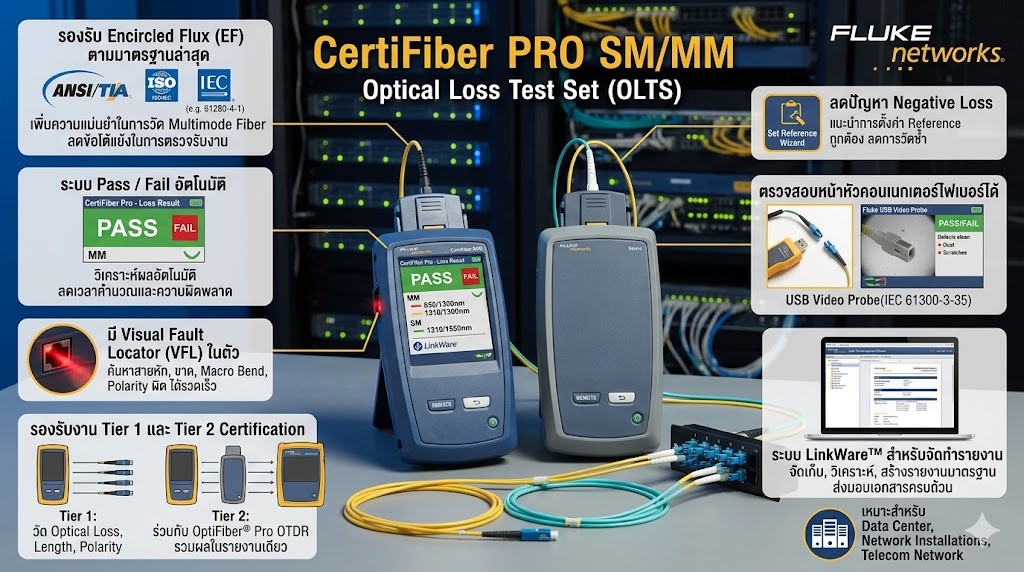
One of the most important requirements for modern Multimode Fiber testing is the use of a light source that complies with the Encircled Flux (EF) standard. This standard was developed to eliminate measurement inconsistencies caused by variations in light launch conditions among different test instruments.
In the past, optical loss measurements taken by different testers could produce significantly different results, even when testing the same fiber link. This discrepancy occurred because each light source launched light into the fiber core differently, creating variations in modal distribution and ultimately affecting the measured loss values. As a result, comparing test results between contractors, inspectors, and project owners often became challenging and sometimes led to disputes regarding measurement accuracy.
CertiFiber PRO has been specifically designed to fully comply with Encircled Flux requirements in accordance with internationally recognized standards, including:
- ANSI/TIA
- ISO/IEC
- IEC
By adhering to these standards, CertiFiber PRO delivers highly accurate, repeatable, and consistent optical loss measurements that can be confidently referenced against industry certification requirements.
This capability is especially important in environments such as:
- Data Centers
- Enterprise Networks
- Campus Networks
- Government Infrastructure Projects
- Telecommunications Networks
where documented test results are required for project acceptance and warranty purposes.
For projects that require formal certification reports, Encircled Flux compliance significantly reduces disagreements regarding measurement validity, ensures consistency between different testing teams, and enhances confidence in the final acceptance documentation. As a result, contractors, consultants, and project owners can rely on the test results with greater assurance throughout the entire project lifecycle.
Automatic Pass/Fail Analysis
Measuring optical loss alone is not enough to determine whether a fiber optic link is acceptable for operation. The measured loss must be compared against the allowable Loss Budget specified by industry standards or project requirements.
When calculations are performed manually, technicians must consider several factors, including:
- The number of connectors
- The number of fusion splices
- Total fiber length
- Applicable testing standards
- Project-specific acceptance criteria
In large-scale projects involving hundreds or thousands of fiber links, manual calculations can be time-consuming and increase the likelihood of human error.
To simplify this process, CertiFiber PRO features an advanced automatic analysis system that immediately evaluates test results against the selected standard. The instrument automatically calculates whether the measured optical loss falls within acceptable limits and displays a clear result directly on the screen:
- PASS
- FAIL
This instant feedback allows technicians and engineers to quickly determine whether a link meets certification requirements without performing additional calculations.
In addition to supporting industry-standard certification limits, CertiFiber PRO also allows users to create and apply custom acceptance thresholds based on specific project requirements. This flexibility makes it suitable for both standard installations and specialized applications with unique performance criteria.
The benefits of automatic Pass/Fail analysis include:
- Reduced test interpretation time
- Faster project acceptance processes
- Improved testing efficiency
- Consistent evaluation across all links
- Reduced risk of human calculation errors
- Greater confidence in certification results
For organizations performing large-scale fiber deployments, this feature significantly streamlines testing workflows and helps ensure that every fiber link is evaluated consistently and accurately according to the required standards.
Reduces Negative Loss Measurement Issues
One of the most common problems encountered by fiber optic technicians is obtaining a Negative Loss reading during testing. In practice, a negative loss value is considered unrealistic because it indicates that the measured signal appears stronger than the reference signal, which should not occur under normal conditions.
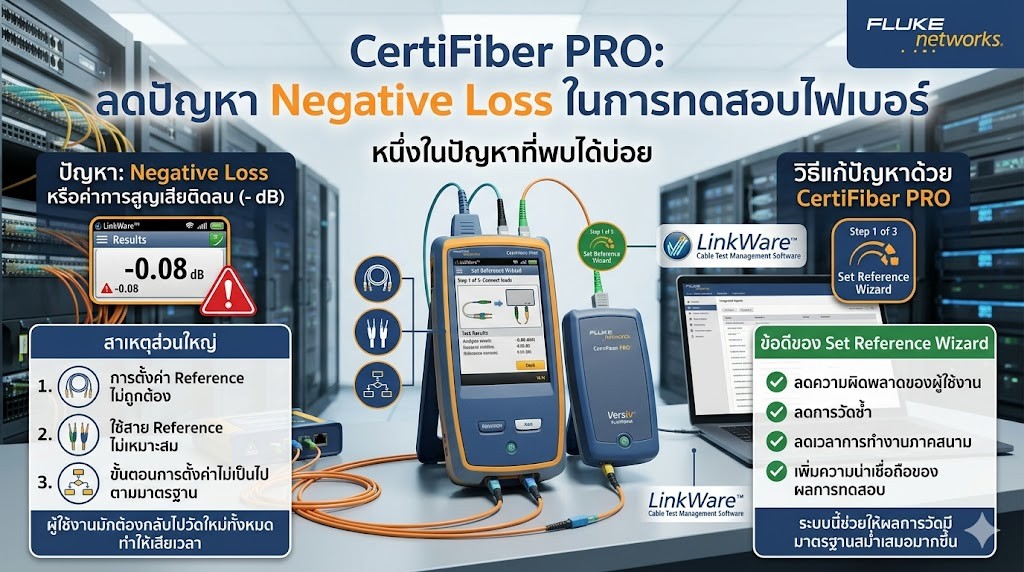
The most common causes include:
- Incorrect reference setting procedures
- Improper reference test cords
- Reference setup steps that do not follow industry standards
When this issue occurs, technicians often need to repeat the entire testing process, resulting in lost time and reduced confidence in the measurement results.
To address this challenge, CertiFiber PRO features a Set Reference Wizard that guides users through the reference-setting process step by step. The system also verifies that the reference has been established correctly before actual testing begins.
Key benefits include:
- Reduces user errors
- Minimizes the need for retesting
- Shortens field testing time
- Improves the reliability of test results
This feature is particularly valuable for organizations with technicians of varying experience levels, as it helps ensure more consistent and standardized test results across the entire team.
Fiber Connector End-Face Inspection Capability
Industry statistics indicate that more than 80% of fiber optic network problems are caused by dirty or damaged connector end faces.
Even microscopic contamination that is invisible to the naked eye can lead to:
- Increased optical loss
- Higher reflectance levels
- Increased bit error rates
- Unstable network performance
CertiFiber PRO can integrate with Fluke Networks’ fiber inspection solutions, allowing technicians to perform detailed connector end-face analysis before testing.
The inspection system can detect:
- Dust particles
- Oil contamination
- Scratches
- Cracks
- Ferrule damage
In addition, the system can automatically evaluate connector cleanliness and condition according to the IEC 61300-3-35 standard.
This ensures that connectors are clean and ready for use before testing begins, helping eliminate measurement errors at the source and improving the overall accuracy of fiber certification results.
Built-in Visual Fault Locator (VFL)
A Visual Fault Locator (VFL) is one of the most valuable tools for on-site fiber optic troubleshooting.
CertiFiber PRO includes an integrated VFL, eliminating the need to carry a separate fault locator device.
The VFL operates by launching a visible red laser into the fiber. If the fiber is damaged, bent, broken, or improperly terminated, the light escapes at the fault location, allowing technicians to quickly identify the source of the problem.
It is highly effective for locating:
- Fiber breaks
- Cracked fibers
- Micro bends
- Macro bends
- Damaged connectors
- Faulty fusion splices
- Polarity issues
By providing immediate visual identification of faults, the built-in VFL can significantly reduce troubleshooting time. In many cases, issues that would normally require hours of investigation can be located and resolved within minutes, improving efficiency and minimizing network downtime.
Supports Tier 1 and Tier 2 Certification
CertiFiber PRO was specifically developed for professional fiber optic certification and acceptance testing.
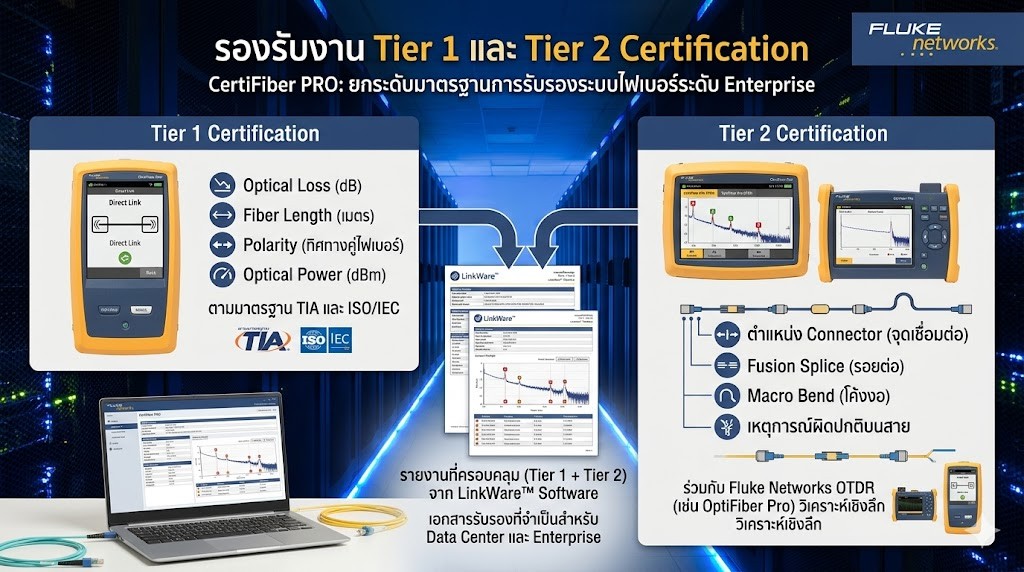
For Tier 1 Certification, the instrument can verify:
- Optical Loss
- Fiber Length
- Polarity
- Optical Power
in accordance with TIA and ISO/IEC industry standards.
Tier 1 testing focuses on confirming that a fiber link meets the performance requirements necessary for reliable network operation. It is the most commonly required certification method for newly installed fiber optic cabling systems and is often specified as part of project acceptance procedures.
For Tier 2 Certification, CertiFiber PRO can be integrated with Fluke Networks OTDR solutions, such as OptiFiber® Pro, to perform detailed event-based analysis of the fiber link.
This enables technicians to identify and analyze:
- Connector locations
- Fusion splices
- Macro bends
- Abnormal events along the fiber link
- Sources of excessive loss
- Reflection points
While Tier 1 testing confirms whether a link passes performance requirements, Tier 2 testing provides deeper visibility into the exact condition of the fiber infrastructure and helps pinpoint the location of potential problems.
When the results from both certification levels are combined, users receive a comprehensive report that covers both the overall performance of the link and the detailed characteristics of every significant event along the fiber path.
This level of documentation is particularly valuable for:
- Enterprise Data Centers
- Telecommunications Networks
- Government Infrastructure Projects
- Large-Scale Campus Networks
- Mission-Critical Network Environments
where comprehensive certification records are often required before final project acceptance.
LinkWare™ Reporting System
Once testing is completed, all results can be transferred directly to LinkWare™ Cable Test Management Software for analysis, documentation, and project reporting.
LinkWare is one of the most widely adopted cable test management platforms in the communications cabling industry and has become a standard reporting solution for contractors, consultants, and network engineers worldwide.
Using LinkWare, users can:
- Store and organize test results
- Categorize fiber links by project or location
- Analyze historical test data
- Compare current and previous test results
- Generate professional PDF reports
- Create complete project handover documentation
The software streamlines the entire reporting process, ensuring that all certification records are properly documented and easy to access when needed.
For large-scale projects involving hundreds or even thousands of fiber links, LinkWare’s automated reporting capabilities can save a significant amount of administrative time. Instead of manually compiling test results, users can generate standardized reports within minutes, improving workflow efficiency and reducing documentation errors.
Key benefits include:
- Faster report generation
- Improved documentation accuracy
- Simplified project handover
- Professional presentation of test results
- Easier warranty and compliance verification
- Long-term record keeping for maintenance and troubleshooting
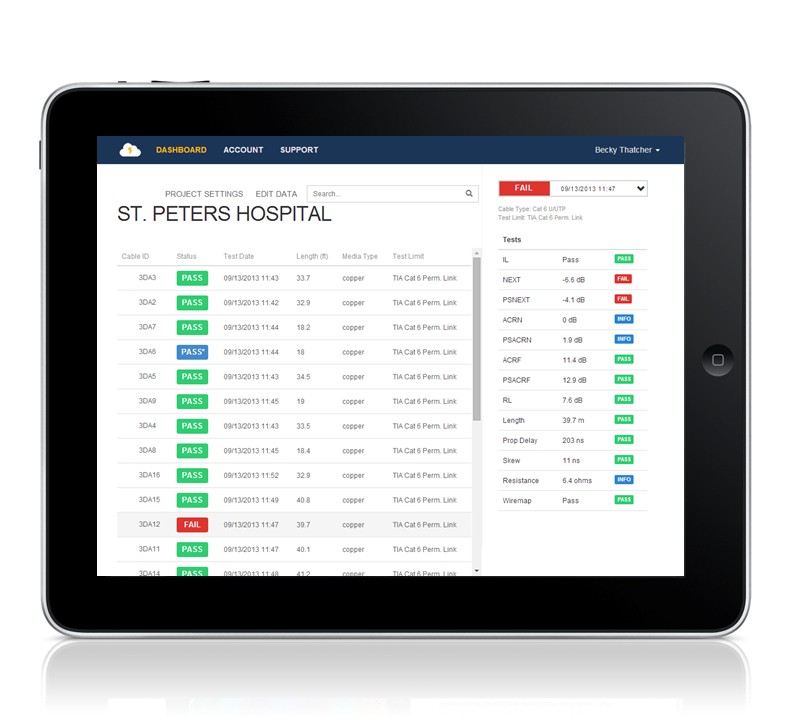
As a result, LinkWare not only enhances productivity but also adds a higher level of professionalism to project delivery, making it an essential component of the fiber certification process for contractors, engineers, and network operators.
Summary
Fluke CertiFiber® PRO SM/MM is a professional-grade Optical Loss Test Set (OLTS) specifically designed for comprehensive fiber optic testing and certification. Supporting both Single Mode and Multimode Fiber, it provides fast and accurate Optical Loss measurements, automatic Pass/Fail analysis, full compliance with Encircled Flux standards, and complete test reporting capabilities through LinkWare™ Software.
With its ability to deliver rapid, precise, and repeatable test results while minimizing user-related errors, CertiFiber PRO has become one of the most widely trusted tools for fiber certification in applications such as:
- Data Centers
- Enterprise Networks
- FTTH (Fiber to the Home)
- Backbone Networks
- Telecommunications Infrastructure
- Large-Scale Fiber Optic Deployment Projects
Its combination of speed, accuracy, advanced certification features, and professional reporting capabilities makes CertiFiber PRO an ideal solution for organizations that require industry-standard fiber optic testing and project acceptance procedures. For contractors, network engineers, data center operators, and telecommunications providers, it remains one of the leading tools for ensuring the quality, reliability, and performance of modern fiber optic networks worldwide.