


In today’s digital era, network systems are no longer expected to be just “functional,” but also fast, stable, and scalable for future growth. This has made Fiber Optic cable the preferred choice for many organizations, ranging from small offices to large-scale Data Centers and enterprise backbone networks.
However, a common question that often arises is: should you choose Single-mode or Multi-mode Fiber?
Although both types are fiber optic cables, they differ significantly in terms of transmission distance, speed, cost, and application design. Choosing the wrong type may lead to hidden costs or limitations in long-term network performance.
This article will help you understand the key differences between Single-mode and Multi-mode Fiber, along with practical guidelines for selecting the right option for each scenario—so you can make a confident and cost-effective decision for your network infrastructure.
Understanding the Two Types of Fiber Optic Cables
1. Single-mode Fiber (SMF)
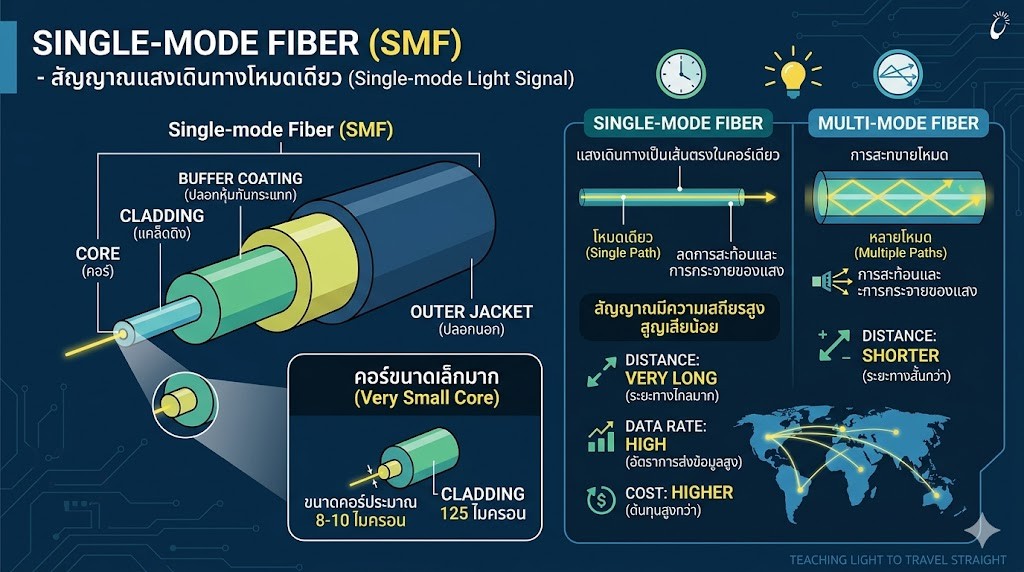
Single-mode Fiber (SMF) is a type of optical fiber designed to allow light to travel through the core in only a single mode. With an extremely small core size (approximately 8–10 microns), light signals propagate in a straight path with minimal reflection and dispersion. As a result, SMF delivers highly stable signals, very low attenuation, and the ability to transmit data over extremely long distances.
Operating Principle
SMF uses a laser light source (such as DFB or FP laser) to transmit light into a very small core. Because of the narrow core size, the light does not bounce at multiple angles like in multi-mode fiber.
As a result:
- It significantly reduces Modal Dispersion (where light signals arrive at different times)
- It delivers signals that are clear, sharp, and highly stable, even over long distances
Wavelength Ranges in Single-mode Fiber Single-mode fiber typically operates in key wavelength windows, including:
- 1310 nm → Suitable for medium-distance transmission
- 1550 nm → Ideal for long-distance transmission (lowest attenuation)
- 1625 nm / 1650 nm → Used for testing and network monitoring purposes
Distance and Speed One of the main advantages of SMF is its superior performance in both distance and speed.
- Distance: From several kilometers up to 100–200 km or more when used with optical amplifiers
- Speed: Supports a wide range of data rates, including:
- 1G / 10G
- 40G / 100G
- Up to 400G+ in modern network systems
SMF is therefore highly suitable for networks requiring high bandwidth, long-distance transmission, and low latency performance.
Standards in Use
OS1 and OS2 are classifications of Single-mode Fiber optic cables defined under international standards (such as ISO/IEC). These standards help ensure that the cable is selected appropriately based on environmental conditions and transmission distance requirements.
OS1 (Indoor Single-mode Fiber)
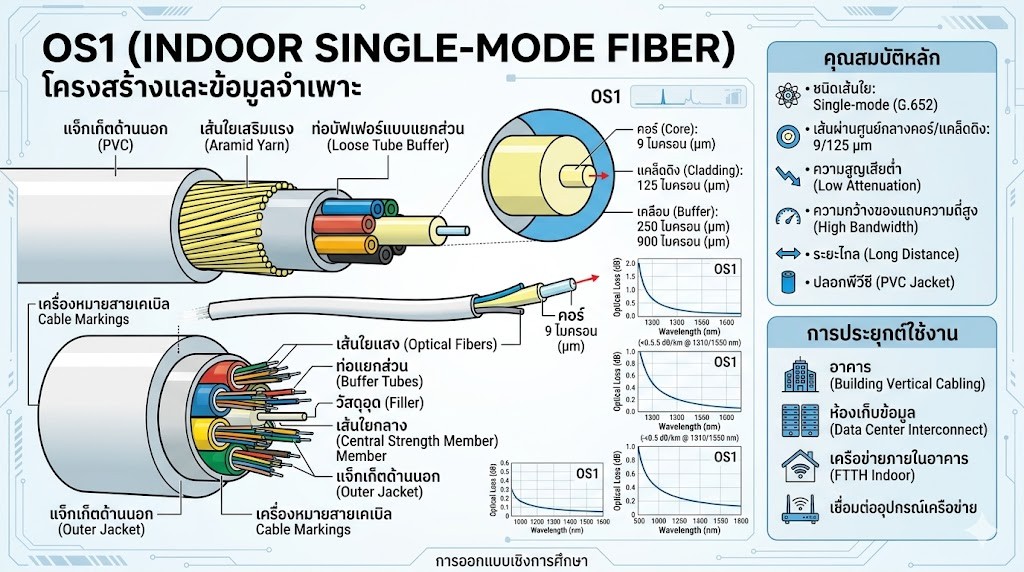
OS1 is a type of Single-mode fiber optic cable designed for indoor applications. It focuses on flexibility, safety, and ease of installation in confined spaces such as inside buildings, equipment rooms, and structured cabling systems.
General Characteristics
- Designed for indoor use
- Typically built with a tight-buffered structure
- Highly flexible, making it suitable for internal cable routing and confined spaces
Key Features
- Attenuation: approximately ≤ 1.0 dB/km
- Easy to install, ideal for limited spaces such as conduits and rack cabinets
- Uses LSZH (Low Smoke Zero Halogen) jacket for safety (flame-retardant and low smoke emission)
Suitable Applications
- Office buildings
- Data centers
- Server rooms / rack systems
Limitations
- Not suitable for outdoor environments
- Supports shorter transmission distances compared to OS2
OS2 (Outdoor / Extended Distance Single-mode Fiber)
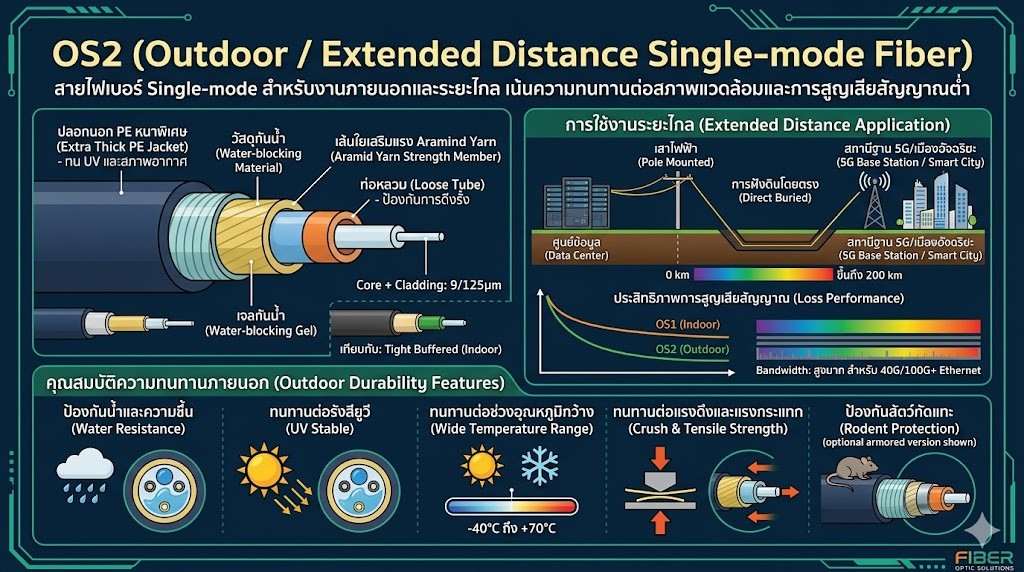
OS2 is a type of Single-mode fiber optic cable designed for outdoor and long-distance applications. It focuses on durability against harsh environmental conditions and provides low signal attenuation for reliable long-range data transmission.
General Characteristics
- Designed for outdoor and long-distance applications
- Typically constructed with a loose tube structure
- Includes protective layers against water, moisture, and physical impact
Key Features
- Lower attenuation: approximately ≤ 0.4 dB/km
- Supports very long transmission distances (tens to hundreds of kilometers)
- Resistant to harsh environmental conditions such as sunlight, rain, and humidity
Suitable Applications
- Inter-building connections (Campus / Inter-building networks)
- Backbone network infrastructure
- ISP / Telecom networks
- Direct buried or outdoor aerial installations
Limitations
- Higher cost compared to OS1
- Cable is more rigid and slightly more difficult to install
OS1 vs OS2 Comparison
| Feature | OS1 | OS2 |
| Application | Indoor | Outdoor / Long Distance |
| Structure | Tight-Buffered | Loose Tube |
| Attenuation | ≤ 1.0 dB/km | ≤ 0.4 dB/km |
| Transmission Distance | Short to Medium Range | Very Long Distance |
| Durability | Moderate | High |
Suitable Applications
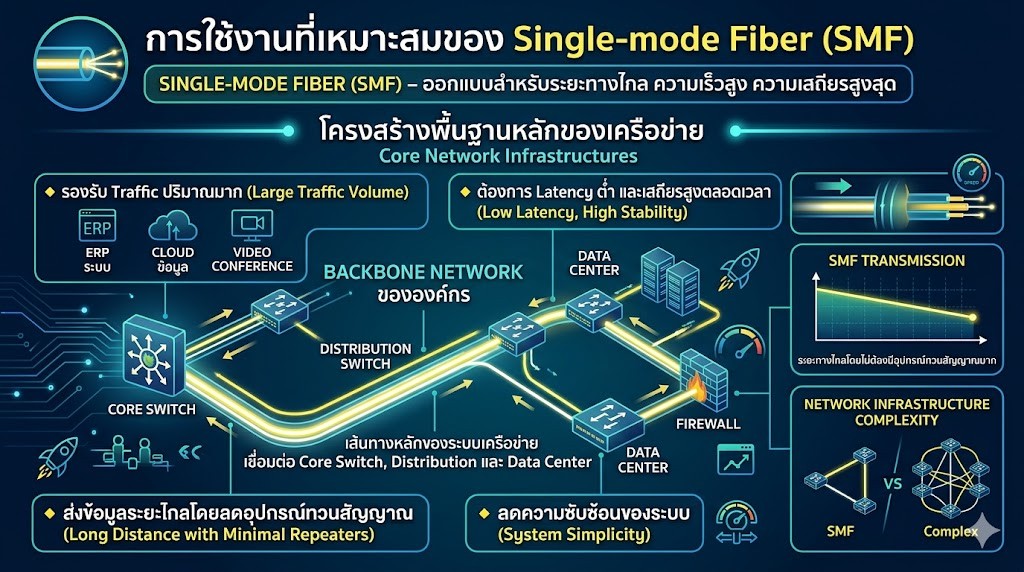
Single-mode Fiber (SMF) is designed for applications that require long-distance transmission, high speed, and maximum stability. Therefore, it is commonly used as a core infrastructure in network systems, such as:
SMF is widely used in high-performance applications, including:
Enterprise Backbone Networks It serves as the main transmission path within large-scale enterprise networks.
- Used to connect Core Switch, Distribution layers, and Data Centers
- Handles large volumes of traffic such as ERP systems, Cloud services, and Video Conferencing
- Requires low latency and consistently high stability
SMF enables long-distance data transmission without the need for frequent signal repeaters, helping to reduce system complexity and improve overall network efficiency.
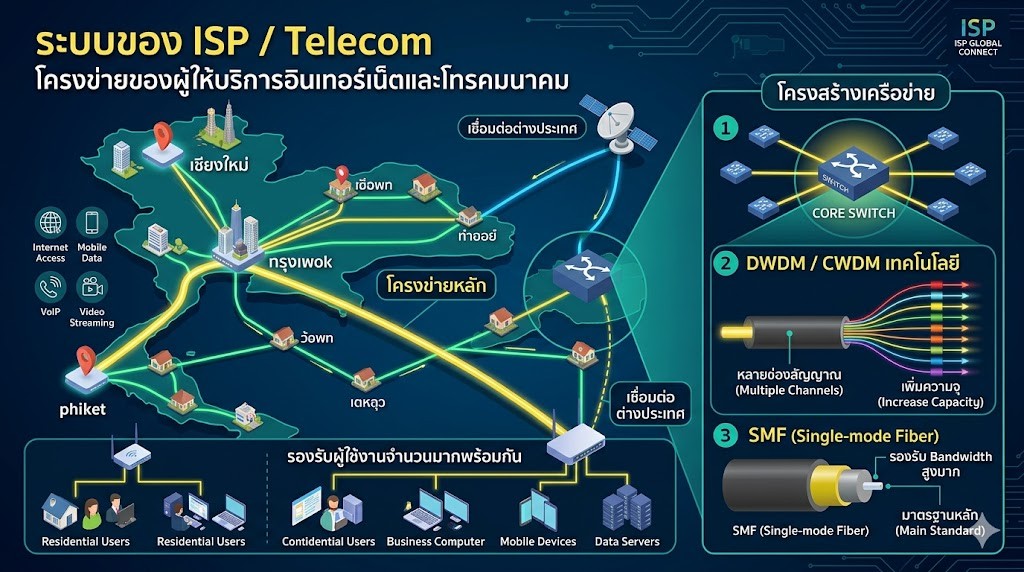
ISP / Telecom Systems Used in the network infrastructure of Internet Service Providers (ISP) and telecommunications operators.
- Connects cities, provinces, or even countries
- Supports a large number of users simultaneously
- Utilizes technologies such as DWDM / CWDM to increase fiber capacity and data transmission efficiency
SMF is the primary standard in telecommunications systems due to its ability to support extremely high bandwidth over long distances with minimal signal loss.
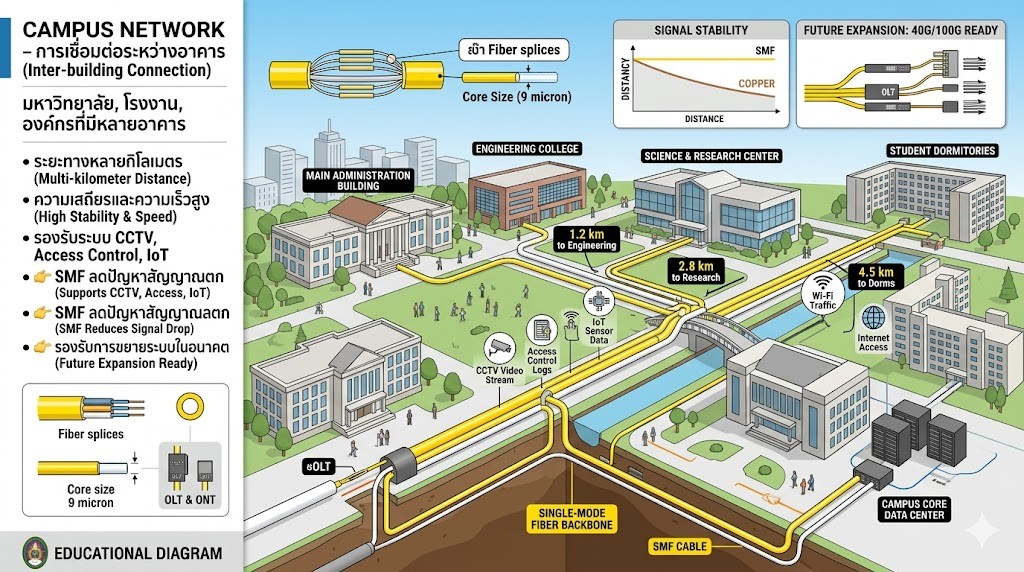
Inter-Building Connections (Campus Network) Used in universities, factories, or organizations with multiple buildings.
- Covers distances ranging from several hundred meters to several kilometers
- Requires stable and high-speed communication between buildings
- Supports critical systems such as CCTV, access control, and IoT applications
SMF helps reduce signal degradation and supports future network expansion efficiently.
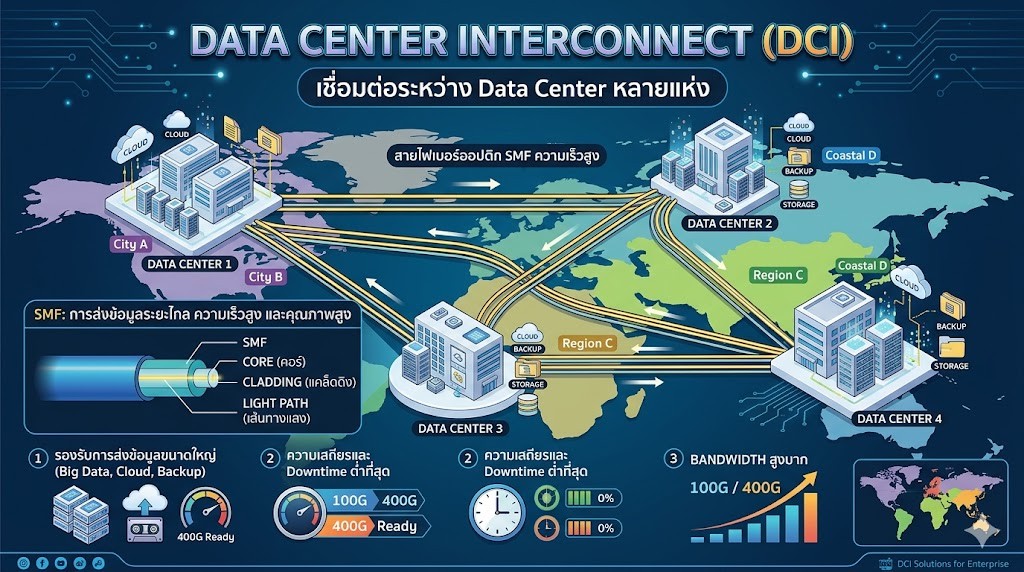
Data Center Interconnect (DCI) Used to connect multiple data centers together.
- Supports large-scale data transmission such as Big Data, Cloud services, and backup systems
- Requires extremely high bandwidth, such as 100G / 400G links
- Must maintain maximum stability with minimal downtime
SMF enables high-quality, high-speed transmission over long distances while maintaining stable performance.
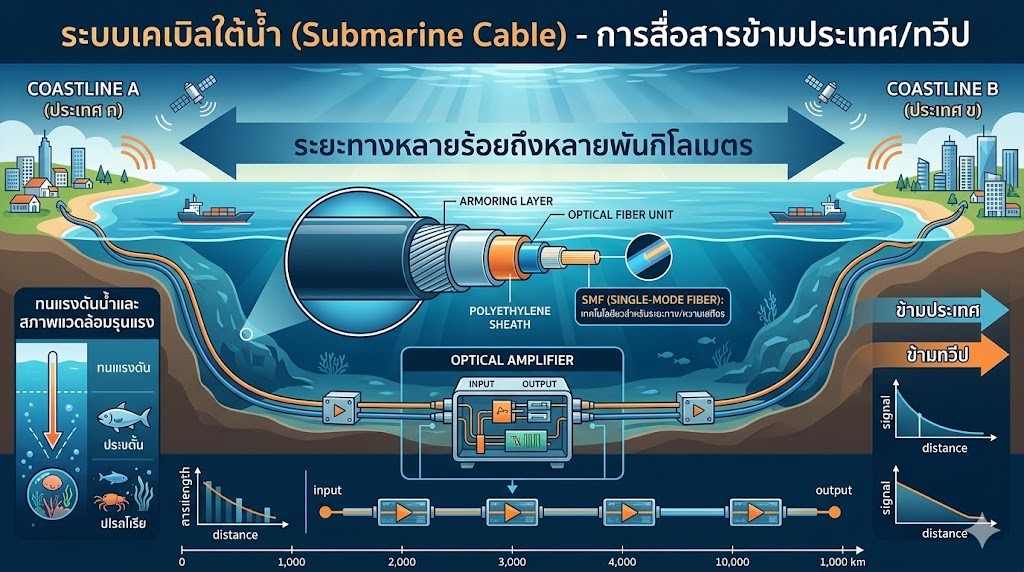
Submarine Cable Systems Used for communication across countries or continents.
- Covers distances ranging from hundreds to thousands of kilometers
- Designed to withstand extreme conditions, including high water pressure and harsh underwater environments
- Operates in conjunction with undersea optical amplifiers to maintain signal strength over long distances
SMF is the only fiber technology capable of supporting this level of transmission distance and stability requirements.
2. Multi-mode Fiber (MMF)
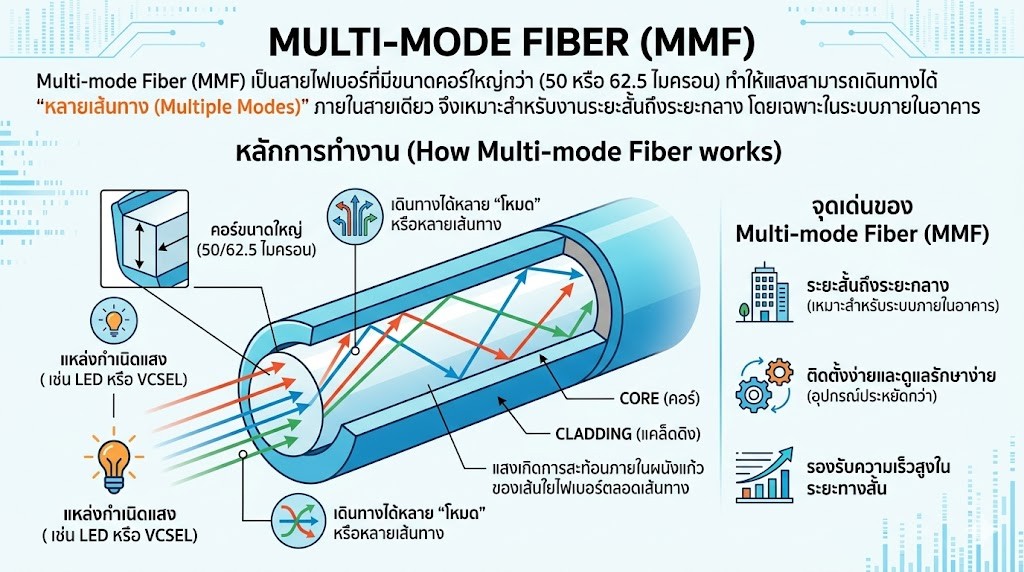
Multi-mode Fiber (MMF) is a type of optical fiber with a larger core size (50 or 62.5 microns). This allows light to travel through multiple paths (multiple modes) within the same fiber, making it suitable for short- to medium-distance applications, especially within indoor environments.
Operating Principle (How Multi-mode Fiber Works)
Because MMF has a relatively large core size (50 or 62.5 microns), the light transmitted into the fiber does not travel in a single straight line. Instead, it propagates through multiple “modes” or paths within the same core.
When light is launched from a source such as an LED or VCSEL, it reflects off the inner walls of the fiber throughout its length. This creates multiple simultaneous zigzag paths of light propagation inside the fiber core.
Why Modal Dispersion Occurs
When light travels through multiple paths simultaneously inside a Multi-mode Fiber, differences arise in both the distance and the time taken for each light path to reach the destination. For example:
- Some light rays travel in a straight path → they arrive faster
- Some light rays reflect multiple times → they take longer to arrive
As a result, the light signals do not arrive at the receiver at the same time, causing overlapping of data signals. This phenomenon is called Modal Dispersion, or the spreading of light signals over time.
Impact on Signal Performance As transmission distance increases, the effects of Modal Dispersion become more severe:
- The signal becomes wider and less defined (blurred)
- The edges of the signal become less sharp (poor signal integrity)
- Bit Error Rate (BER) increases, leading to more transmission errors
- Overall data transmission efficiency decreases
The longer the fiber length, the more noticeable these effects become.
Why Multi-mode Fiber is Suitable for Short Distances
Although MMF is affected by Modal Dispersion, its impact is minimal over short distances because:
- The time difference between light paths is still small
- Signals remain sufficiently synchronized
- High speeds can still be supported (e.g., 10G / 40G / 100G over short ranges)
Therefore, MMF is ideal for applications that require high speed but short transmission distances, such as Data Centers and in-building LAN networks.
Simple Comparison for Better Understanding
- Single-mode Fiber = Light travels in a single path → sharp signal, long distance
- Multi-mode Fiber = Light travels in multiple paths → fast in short distance but spreads over long distance
The principle of MMF is to allow light to travel through multiple paths simultaneously. This makes installation easier and reduces cost, but it also introduces Modal Dispersion, which is its main limitation.
Therefore, MMF is designed for short-distance, high-speed applications rather than long-distance transmission.
Types of Multi-mode Fiber (OM Standards)
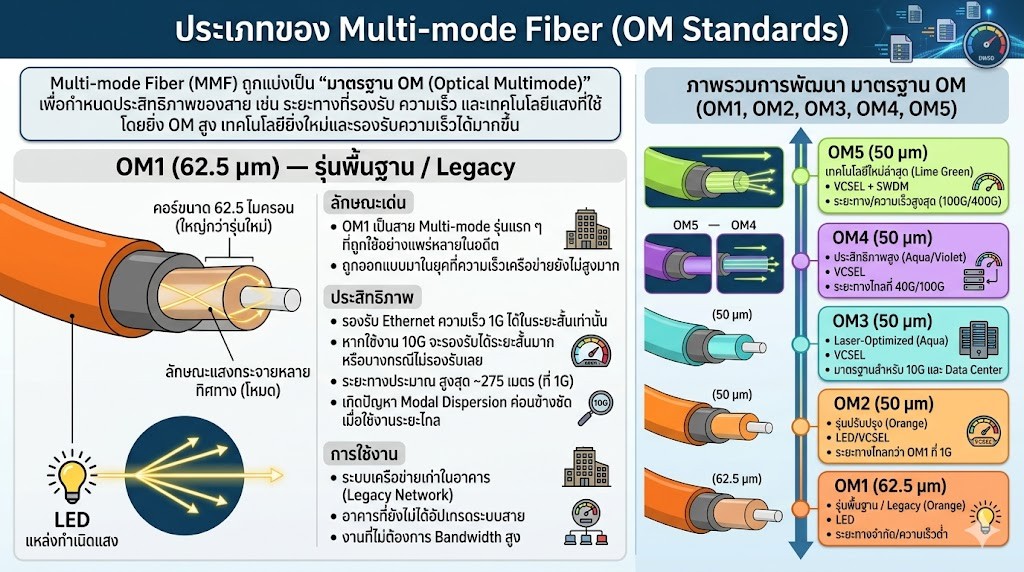
Multi-mode Fiber (MMF) is categorized into “OM (Optical Multimode)” standards, which define the performance characteristics of the fiber such as supported distance, transmission speed, and light technology used. In general, the higher the OM grade, the more advanced the technology and the higher the data transmission capability.
1. OM1 (62.5 µm) — Basic / Legacy
Key Characteristics
OM1 is one of the earliest widely used multi-mode fiber types in legacy network systems.
It uses a 62.5-micron core, which is larger than newer standards, and typically relies on LED light sources, causing light to disperse in multiple directions. It was designed during an era when network speeds were relatively low.
Performance
- Supports 1G Ethernet only over short distances
- 10G is either very limited or not supported in most cases
- Maximum distance is approximately 275 meters (at 1G)
- Strong Modal Dispersion over longer distances affects signal quality
Applications
- Legacy building network systems
- Facilities that have not upgraded cabling infrastructure
- Low-bandwidth applications
2. OM2 (50 µm) — Improved Version
Key Characteristics
OM2 uses a 50-micron core, which improves light control compared to OM1.
It reduces Modal Dispersion effects, while still commonly using LED-based light sources in some systems.
Performance
- Supports 1G up to approximately 550 meters
- Supports 10G at short distances (~82–150 meters)
- Suitable as an upgrade from OM1 but not ideal for full Data Center performance
Applications
- Medium-sized enterprise LAN networks
- General office buildings
- Basic to mid-level network environments
3. OM3 (Laser Optimized) — Most Popular Standard
Key Characteristics
OM3 is optimized for VCSEL laser light sources, providing much better control of Modal Dispersion.
It is designed specifically for high-speed transmission in short distances.
Performance
- Supports 10G up to ~300 meters
- Supports 40G / 100G over short distances
- Ideal for high-speed applications with limited distance requirements
Applications
- Small to medium Data Centers
- Enterprise networks
- Server-to-switch connections
4. OM4 — High-Performance Standard (Data Center Grade)
Key Characteristics
OM4 is an enhanced version of OM3 with higher bandwidth and improved transmission stability.
It is specifically designed for modern Data Center environments.
Performance
- Supports 10G up to ~400 meters
- Supports 40G / 100G up to ~150 meters
- Better suited for future network upgrades
Applications
- Large-scale Data Centers
- Cloud and virtualization systems
- High-traffic enterprise networks
5. OM5 — New Generation (SWDM Technology)
Key Characteristics
OM5 supports SWDM (Short Wavelength Division Multiplexing) technology, allowing multiple wavelengths to be transmitted through a single fiber.
This reduces the need for additional cabling in high-density environments.
Performance
- Increases data capacity without increasing fiber count
- Supports 40G / 100G and up to 400G in some systems
- Optimized for high-density network infrastructures
Applications
- Next-generation Data Centers
- Large-scale cloud infrastructure
- High-density cabling environments
Overall Summary of OM Standards
- OM1 / OM2 → Legacy systems / basic LAN
- OM3 → Standard for modern Data Centers
- OM4 → High-performance enterprise and large Data Centers
- OM5 → Next-generation cloud and high-density networks
Comparison: Single-mode vs Multi-mode Fiber
| Feature | Single-mode (SMF) | Multi-mode (MMF) |
| Core Size | 8–10 µm | 50 / 62.5 µm |
| Light Source | Laser | LED / VCSEL |
| Transmission Distance | Very long distance (10–100+ km) | Short distance (100 m – 2 km) |
| Speed | Very high | High (but distance-limited) |
| Cost | Higher | More cost-effective |
| Applications | Backbone networks, ISP, inter-building connections | LAN, Data Centers |
Which One Should You Choose? Decision Guidelines
Choosing between Single-mode Fiber (SMF) and Multi-mode Fiber (MMF) is not based on price alone. It should depend on real-world usage factors such as transmission distance, speed requirements, and future network expansion plans.
When to Choose Single-mode Fiber
- When long-distance transmission is required (over 500 meters to several kilometers)
- For core network infrastructure (Backbone Network)
- When future scalability and system expansion are important
- For ISP, telecommunications, or inter-building connectivity
When to Choose Multi-mode Fiber
- For indoor or short-distance applications
- In Data Centers or server rooms
- When cost control is a key factor
- When long-distance transmission is not required
Additional Considerations
- Total Cost: Not only the cable price, but also transceivers and related equipment must be considered
- Future Scalability: If future expansion is expected, SMF may be more cost-effective in the long run
- Installation Environment: Indoor, outdoor, or distance requirements all play a role in selection
- Standards in Use: Such as OM3 / OM4 for MMF or OS2 for SMF
In summary, the right choice depends on your network goals:
SMF is ideal for long-term, high-performance backbone systems, while MMF is best for cost-effective, short-distance indoor networks.
Fiber Optic Test Equipment Comparison: SMF vs MMF
| Test Equipment | 🔹 Single-mode Fiber (SMF) | 🔸 Multi-mode Fiber (MMF) |
| OTDR (Optical Time Domain Reflectometer) | Used for detailed fiber analysis, identifying breaks, splices, and signal loss. Ideal for long-distance networks such as Backbone, ISP, and Telecom systems. | Used for fiber analysis and troubleshooting in LAN and Data Center environments. Detects faults and abnormalities in short- to medium-distance networks. |
| Optical Power Meter & Light Source (OLTS) | Used to measure end-to-end optical loss for SMF certification according to TIA/ISO standards. Supports 1310 / 1550 nm wavelengths. | Measures insertion loss in MMF cables (OM1–OM5). Used for certification in Data Centers and LAN installation projects. |
| CertiFiber™ Max Optical Loss Test Set | Can be used (some models support SMF) for accurate loss measurement and acceptance testing. | Primary tool for MMF certification. Provides fast and standardized reporting, ideal for OM3 / OM4 / OM5 systems. |
| Visual Fault Locator (VFL) | Used for basic inspection such as fiber breaks, loose connectors, or visible light leakage. | Used for the same basic troubleshooting tasks, especially for fast on-site inspection. |
| Main Application Focus | Long-distance transmission, deep analysis, backbone infrastructure | Short-distance networks, installation testing, and indoor systems |
| Overall Strength | High precision, suitable for large-scale backbone networks | Easy to use, fast testing, ideal for Data Center and LAN environments |
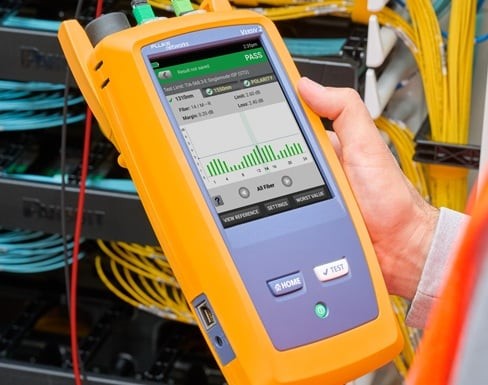
CertiFiber™ Max Optical Loss Test Set
- Accurately measures End-to-End Optical Loss (Insertion Loss) of fiber optic cables
- Supports testing for both Single-mode (SMF) and Multi-mode (MMF) fibers
- Designed for Certification testing according to TIA/ISO standards
- Reduces testing time with fast and automated measurement results
- Ensures installation quality before final handover (Pre-Commissioning verification)
- Supports multiple wavelengths such as 850 / 1300 / 1310 / 1550 nm
- Verifies connectivity accuracy and identifies splice and connector loss issues
- Generates professional test reports suitable for project documentation
- Reduces on-site risks such as signal degradation or excessive loss beyond standards
- Ideal for Data Centers, enterprise networks, and telecom infrastructure projects
Summary
The selection between Single-mode and Multi-mode Fiber Optic cables mainly depends on network requirements such as transmission distance, speed, and budget.
Single-mode Fiber is designed for long-distance transmission with high speed and low signal loss. It is commonly used in backbone networks, telecommunications systems, ISP infrastructure, and inter-building or data center connections where long-term stability and scalability are required. Although it has a higher cost, it offers excellent long-term value and supports future technology upgrades effectively.
On the other hand, Multi-mode Fiber is suitable for short- to medium-distance applications such as indoor networks, LAN systems, and data centers. It offers lower cost, easier installation, and high-speed performance over short distances. However, it has limitations in transmission distance and is affected by light dispersion, which can reduce signal quality over longer runs.
Therefore, the choice depends on the system design. For backbone infrastructure and long-distance communication, Single-mode Fiber is more suitable. For cost-effective, short-distance internal networks, Multi-mode Fiber is the better option.
In conclusion, selecting the right fiber optic type from the beginning helps improve network efficiency, reduce operational issues, and ensure scalable and reliable network growth in the future.
.
If you need to rent network testing equipment or require installation services, feel free to inquire for more information at Metro Technology Co., Ltd. or click here to contact us.