


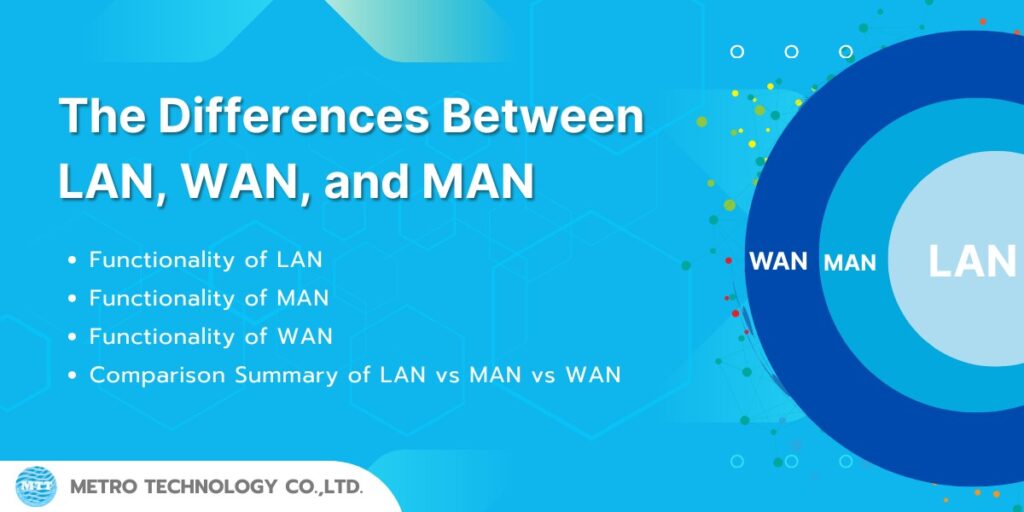
In an era where technology plays an increasingly significant role in daily life and business, computer networks are considered the backbone of data connectivity—whether for accessing online information or enabling fast communication. These networks can generally be categorized into three main types: LAN, MAN, and WAN. Each type has distinct characteristics depending on the coverage area, speed, and installation requirements.
In this article, we’ll explore what sets LAN, MAN, and WAN apart and help you understand which type is most suitable for specific uses, locations, and purposes.
LAN (Local Area Network)
A LAN is a computer network that connects devices within a limited area, such as within a single building or nearby locations where cabling can be directly installed. It commonly uses cables known as “LAN cables” as the medium to transfer data between computers.

Functionality of LAN
Limited Area
A LAN connects computers and other devices within a confined area, such as a single building, office, or classroom. The typical coverage range is within 1 to 5 kilometers.
High Speed
LANs offer high data transfer speeds ranging from 10 Mbps up to 10 Gbps, depending on the technology and equipment used—such as high-speed Ethernet or Wi-Fi in wireless LAN setups.
Shared Communication Medium
Most LANs use Ethernet cables to connect computers and devices. Wireless LANs (WLANs) use Wi-Fi as the medium for connectivity.
Resource Sharing
Devices within a LAN can efficiently share data and resources, such as files, printers, or internet connections, making collaboration seamless.
High Security and Reliability
Because LANs operate within a limited and controlled area, security measures can be effectively implemented—such as firewalls, encryption, and authentication systems—to prevent unauthorized access.

LAN Works
Connecting Devices Through a Central Device
Most LANs use central connecting devices such as a switch or hub to manage data transmission between devices in the network. A switch helps direct data to the correct destination, reducing network congestion.
Packet-Based Data Transmission
Data on a LAN is divided into packets and transmitted through cables or wireless signals. Each computer has a Network Interface Card (NIC) responsible for connecting to the network and handling data transmission according to specific communication protocols.
Medium Access Control (Ethernet CSMA/CD)
In wired Ethernet LANs, a method called CSMA/CD (Carrier Sense Multiple Access with Collision Detection) is used to avoid data collisions. Devices check whether the communication channel is free before sending data. If a collision occurs, they stop and wait a random amount of time before trying again.
Network Topology
There are three main types of LAN topologies (network connection layouts), including:

Bus — Uses a single communication cable to connect all devices. Data flows in both directions until it reaches its destination, and T-Connectors along with terminators are used to prevent signal reflections.

Star — All computers are connected to a central device such as a hub or switch, and all data is transmitted through this central point.

Ring — Computers are connected in a circular layout, and data is transmitted in one direction using a token to control the order of data transmission.
Resource Management and Security
LANs often include additional devices such as routers to connect to the internet and manage data traffic, as well as firewalls to protect against external attacks. A central server is also commonly used to manage data and control user access permissions.
Advantages of LAN
Efficient Resource Sharing
Users within a LAN can share hardware devices such as printers, scanners, or storage, which helps reduce costs by avoiding the need to purchase duplicate equipment.
Convenient and Fast Access to Data and Files
Files can be stored on a central server, allowing users to access them from multiple locations without needing to create individual backups. This also helps minimize the risk of file loss.
High Data Transfer Speeds
LANs provide high-speed data transmission, especially when using LAN cables that meet CAT6 standards or higher, supporting speeds up to 10 Gbps. This enables fast and efficient data transfer.

Higher Security Compared to Wireless Networks
Wired connections reduce the risk of hacking or external attacks better than Wi-Fi because they cannot be accessed directly from outside the network.
Easier to Control and Manage
Network administrators can efficiently assign access rights and control network usage. It is also easy to expand the system by adding more users.
Supports Collaboration Among Various Devices
Computers running different operating systems and various types of devices can work together within the same network.
Suitable for Office Automation Systems
Helps ensure smooth and efficient operations within organizations.
Reduces Long-Term Costs
By allowing shared resources and minimizing the need for duplicate equipment, it lowers investment and maintenance costs compared to other systems.
Disadvantages of LAN
Limited Coverage Area
LANs are suitable for use within a confined area such as a single building or nearby locations but are not ideal for long-distance connections.
Dependence on Cables
If the LAN cable is damaged or broken, data transmission will be interrupted until the cable is repaired.
Complex Installation and Mobility Issues
Setting up LAN cables requires careful planning and installation, making it inconvenient for off-site use or frequent device relocation.
Variety of Devices and Standards
Due to the diversity of devices and software within the network, managing standards and maintenance can be challenging.
Security Is Not Perfect
Although more secure than wireless systems, LANs still face security risks such as unauthorized access if proper controls are not in place.
Distributed Database Systems
Data distributed across different user points can lead to difficulties in data management and reduced performance.
Software and System Limitations
Certain LAN software can be expensive and less developed compared to large-scale systems like mainframes or minicomputers.
Performance Risks During Network Congestion
When there are too many users or excessive data traffic, bottlenecks may occur, causing a decline in network performance.

The LAN system offers advantages in terms of security and stability but has drawbacks when it comes to maintenance complexity.
LAN provides high security and stability because the wired connection makes it more difficult to be hacked or have data intercepted compared to wireless systems like Wi-Fi, where data is transmitted via radio waves that can be more easily intercepted. Additionally, LAN offers more stable data transmission as it is less susceptible to external interference such as radio signals or other electrical devices.
However, LAN has disadvantages in maintenance, which can be quite complicated and challenging. A LAN network typically involves a variety of devices and computers, making it difficult to manage operational standards and network upkeep. Proper management is necessary to maintain the system’s security and performance. Moreover, installing and repairing LAN cables when damaged requires time and expertise, resulting in more complex maintenance compared to wireless systems.
In summary, LAN is a network system that connects computers within a limited area to exchange data and share resources. It primarily uses three connection topologies: Bus, Star, and Ring. Each has its own pros and cons and LAN is widely used in offices, schools, and homes.
MAN (Metropolitan Area Network)

Key Feature of MAN (Metropolitan Area Network)
Coverage Area
A MAN covers an area of approximately 5 to 50 kilometers, which is larger than the coverage of a LAN (limited to a building or nearby vicinity) but smaller than a WAN that spans across countries or continents.High Speed
MAN uses high-speed connection technologies such as fiber optic cables, high-frequency wireless connections, or other technologies that support fast data transmission, enabling efficient and rapid communication between multiple LANs.

Connecting Multiple LANs
A MAN links several LANs within the same city or campus, facilitating easier sharing of data and resources among them.Reliability and Stability
MAN systems are typically designed with redundant links to prevent network failure and ensure continuous connectivity even if parts of the network encounter issues.

Management and Security
Careful planning and system management are required, including setting up security measures such as data encryption and access control systems to prevent attacks and unauthorized data access.
Uses and Benefits of MAN
- Connects offices or organizations with multiple branches within the same city.
- Provides high-speed internet services to users in the city.
- Used in public utilities such as public transportation systems, emergency services, and banking systems.
- Supports collaboration and resource sharing such as central servers, printers, or large databases.
Technologies that Enhance MAN Security and Stability
- Access Restriction to Authorized Users Only
MAN systems configure access controls to ensure that only authorized users or devices can connect to and use the network, preventing unauthorized access.
Data Encryption
Encryption technology is used to protect data during transmission, preventing eavesdropping or tampering by outsiders. Examples include encryption on Ethernet or cloud systems.

- Intrusion Detection and Prevention Systems (IDPS)
These systems analyze network behavior and threats using machine learning to quickly identify and respond to cyberattacks. - Fiber Optic Cables
Using fiber optic cables as the transmission medium within MAN enhances stability and security due to resistance to electrical interference and low signal loss, allowing data to be transmitted over long distances quickly and without quality degradation. - Redundant Links
MAN systems are often designed with backup routes for data transmission to prevent network failure if the main route experiences problems, thereby increasing stability and continuous connectivity. - Modern Network Management Technologies
Technologies like Intel® Active Management Technology (AMT) enable IT teams to manage and maintain the network remotely with efficiency and security.
Overall, these technologies help make MAN highly secure and stable, providing reliable network services over large metropolitan areas or wide regions.
Summary of MAN
MAN is a network that connects multiple LANs within a city or a large area, using high-speed technologies such as fiber optics to enable fast and efficient communication and data exchange. It typically covers an area from 5 to 50 kilometers and offers high reliability through redundant routes and appropriate security measures.
WAN (Wide Area Network)

WAN (Wide Area Network)
WAN is a computer network that covers a large geographic area such as cities, countries, or even continents. WAN connects multiple smaller networks such as LANs or MANs, enabling communication and data exchange between distant locations.
Key Feature of WAN
Wide Coverage Area
WAN can connect networks over very large areas, from multiple cities and countries to worldwide. The Internet is the largest example of a WAN.
Use of Various Media and Technologies
WAN uses multiple transmission media including telephone lines, fiber optic cables, satellites, and public networks. It also employs technologies like MPLS, ATM, Frame Relay, and SD-WAN to support efficient and reliable data transmission.
Speed and Bandwidth
Generally, WANs have lower data transfer speeds than LANs due to the long distances and diverse media used, but technologies exist to improve performance and reduce latency.
Centralized Management
WANs often feature centralized management for critical services such as data storage, security, and access control to ensure efficient and secure operations.
Security and Reliability
WAN implements strict security measures such as data encryption, firewalls, and VPNs to protect against attacks and unauthorized access. It also includes redundant routing to enhance network stability.
Main Components of WAN
Router
Devices that connect and forward data between different subnetworks.

Switch
Connects devices within the same network and directs data to the correct destination.
Modem
Converts data signals for transmission over different media such as telephone lines or satellites.


WAN Applications
- Connecting offices or branches of an organization located in different parts of the world.
- Serving as the infrastructure for the Internet to connect users globally.
- Supporting communication and collaboration between remote locations.
- Used in banking systems, telecommunications, and other public services.
How WAN Connects Networks Across Countries
WAN connects networks in multiple countries using various technologies and methods, including:
- Leased Lines
Point-to-point connections between two distant locations, renting communication lines such as fiber optic or digital telephone lines from telecom providers for high-speed, stable data transmission. - Virtual Private Network (VPN)
Uses data encryption and creates virtual communication channels over public networks like the Internet to ensure secure and private data exchange between offices or users in different countries. - Multiprotocol Label Switching (MPLS)
A routing technique using labels to manage data paths efficiently and reduce latency, suitable for highly reliable inter-country network connections. - Fiber Optic and Satellite Technologies
Use of high-speed fiber optic cables that transmit data over long distances with minimal loss, along with satellite communication for remote or cable-less areas. - Software-Defined WAN (SD-WAN)
Technology that manages WAN connections through software, enabling flexible and efficient use of broadband internet links alongside leased lines. - Protocols and Standards like TCP/IP, Frame Relay, ATM, SONET/SDH
Used for managing and transmitting data effectively over long-distance WAN networks and supporting various data types.
Summary of WAN
WAN is a network that connects multiple smaller networks over very large areas to enable efficient data exchange and communication even across great distances. It employs diverse technologies and transmission media to support fast, reliable, and secure data transfer.
Summary comparison of LAN vs MAN vs WAN
| Feature | LAN | MAN | WAN |
| Coverage Area | Home, single office | Single city, campus | Across provinces, countries, continents |
| Speed | High (100 Mbps – 10 Gbps) | Medium to high | Medium to low (depends on network) |
| Cost | Low | Medium | High |
| Management Complexity | Low | Medium | High |
| Example Usage | File sharing, printing at home | University network system | ATM systems, international communications |
.
If you’re interested in or if you need to rent network testing equipment or require installation services, feel free to inquire for more information at Metro Technology Co., Ltd. or click here to contact us.